Faster by Design
Exploring Technology's Role in Modern Sports
On October 12, 2019, Eliud Kipchoge became the first person ever to run a sub-2-hour marathon in Vienna. Kipchoge ran at a pace of 2:50/km (4:34/mile) for 42km (26mi), a phenomenal athletic feat. However, his attempt sparked major controversy throughout the running world. Firstly, this was a private event with a roster of 40 or so of the world's top long-distance runners pacing Kipchoge. He was handed water bottles and energy gels directly by support teams on bikes, rather than having to stop to pick them up from stands, as one would in a regular marathon. He had a pace car that projected lasers onto the ground, keeping his pacers organized in a formation that was optimized for air resistance.
What generated the greatest controversy by far was the fact that Kipchoge was kitted out with a fresh pair of “Nike Air Zoom Alphafly NEXT%” shoes. These shoes introduced the world to the latest and greatest running tech people were using to get faster times, namely air bubbles, special foam, and most importantly, a carbon plate (Nike). What people didn’t like was the fact that it felt as if Kipchoge “cheated”. He used a pair of so-called “super-shoes” that helped him run such a fast time. To add fuel to the fire, these shoes were not yet available for purchase by the public. For some, this unfairly available technological boost crossed the line. Others argued that even with all these edges, no one else could match Kipchoge, and the run was indeed fair. This argument raised questions I needed to resolve: How much of a technology boost should be acceptable?
Why do we watch sports? Is it for the game or for the athlete?

There was another time when the appearance of technology in sports made some people uncomfortable. On 1 September 2016, FIFA successfully conducted its first official test of Video Assistant Referees (VAR) during the friendly match between Italy and France in Bari (INSIDE FIFA). FIFA has since adopted VAR across many of its major leagues, including the World Cup, Premier League, and Champions League (AnalyiSport). It is a system in which a team of assistant referees monitors multiple high-speed cameras in a room off the football pitch. Whenever the referee is uncertain about a particular play, they can consult the VAR operators via a terminal that displays graphics and provides multiple angles to determine the proper outcome.
Some fans argued that this new millimeter-level precision in a play's legality removed the “humanness” of the sport. An official responsible for the implementation of VAR stated in a NYT article, “We’ve lost the on-field elbow from the game. The number of red card tackles has diminished because players are more careful. You don’t get free hits because you’re on the blind side of the ref” (Buckingham).
This rejection of ultra-technical games really resonates with me. Humans are messy, and by extension, so are sports. Of course, a game without any rules at all would be chaotic and probably not much fun at all. But to throw the rulebook at every play removes the game's character. I mean, the time I probably enjoy sports most is when I'm playing with friends in a barely legal game of basketball, in a light-hearted atmosphere where missing hoops is ok. “Goals are often celebrated twice now - once when the ball enters the net and again when the VAR check confirms that the goal will stand“ (AnalyiSport). Not to mention the extended time it takes for a decision, sometimes up to five minutes. This added tension seems unnecessary and takes away a bit of the game's character.
But how much does this new technology affect athletes' performance? In the NYT article, Buckingham (Buckingham) pointed out a measurable drop in red cards, but I found that many of the arguments against VAR, like this one, seem to be about subjective calls, such as red cards or offside goals. I can understand why football spectators would be annoyed to see a goal retroactively taken away from their favorite team, but I wanted to explore a more objective way to assess any recent technological impact on sports. In fact, I initially didn’t think a new pair of shoes could make that much of a difference in Kipchoge’s run.
I was very surprised to find that, in fact, the answer is that they do.

In a study, Muniz-Pardos makes the bold claim that all recent record-breaking runs, including Kipchoge's, were only possible because of all the new shoe technology, especially carbon plates. The most damning evidence is a giant tablestandout of recent world records set in the past five years, since carbon-plated shoes were first used. Pretty much every record from 5k to 10k to the half-marathon was set with carbon-plated shoes (Muniz-Pardos, 373). The article goes on to explore how they even help in the first place. To run quicker, you can either improve your biomechanics (how you run) or minimize the energy you lose with every stride. Previous studies suggest that flexibility in the forefoot or metatarsophalangeal joints (or as you may know them, “toes”) increases energy losses during running. Carbon-plated shoes reduce this flexibility, thereby lowering energy expenditure and allowing people to run faster and further.
The evidence points to one ugly fact: were it not for the carbon-plated shoes, Kipchoge’s run would never have been possible, despite his athletic ability. He did genuinely run a marathon under 2 hours, but maybe he was “cheating”. There is also a wider discussion of fairness and sports that I would rather not get into, such as access to funding/resources that lead to better technology. So, Kipchoge's run was only possible because of technology; some people saw it as unfair, but is there a sport that relies on technology and that people love?

BattleBots describes itself as “An intense, fast-moving, family-friendly, fight-fest starring robots that have delighted millions of fans all over the world”. Fundamentally, this is a competition that promotes competition and innovation by creating robots powered by modern electronics that fight each other to a robotic death in a televised arena to millions. This is why I initially thought it would be a good subject to explore the influence of technology on sports; Battlebots doesn’t even rely on human athletes to begin with. Instead, it uses human intuition, creativity, and engineering to promote competition. Seemingly, it has millions of fans, so how do we replicate its successes across other sports?
Yet this didn’t feel in the spirit of what I wanted to answer; my focus on this piece was on how human athletes have been enhanced by sport. While the question of “robot athletics” remains fascinating, I wanted to refine my question to focus on the human. What is an example of a positive impact for viewers that has come about due to human athletes using new technology? Is there a sport that has changed so fundamentally because of technology that we are unaware of how much it has?
Is there a sport that has changed so fundamentally because of technology that we are unaware of how much it has?
ChatGPT says there is: Tennis! ChatGPT pointed out a few ways in which tennis has really developed in the past century, most significantly, racquet technology and Hawk-Eye. Hawk-Eye is a technology that uses high-speed cameras to predict the ball's motion and provide a quick resolution to players' challenges (TennisHQ). It provides a much more accurate call than humans; it has an error of only 2.6mm and displays graphics of the call that show the system's thought process. This sentiment around Hawk-Eye is totally different from that of VAR. While I could find criticisms of Hawk-Eye and some of its potentially faulty calls, it generally seemed much more widely accepted and loved than VAR. The biggest praise for Hawk-Eye has been that it has led to significantly fewer disputed rulings and has delivered them in a fraction of the time compared to human judgment. Hawk-Eye also seemed to become significantly more accepted as “the future” during COVID. Human line judges were not allowed due to social distancing, so Hawk-Eye was a key technology that even made tournaments possible in the first place.
In fact, Hawk-Eye was such a hit that tennis no longer relies on human judges (Boyo). Furthermore, it is being adopted into other leagues such as the NBA, as Theresa Alesso, president of Imaging Products and Solutions Americas at Sony, said: “Our goal is really to make sports safer, fairer and more exciting for the fans”. Surely they would have learned something from VAR fans who hated it? Apparently not, according to an article by Aron Philofer, who cites fairly recent technological innovations and immediacy as the main reasons. When it came to VAR, fans' biggest gripe was how long it took only to be told that the goal was offside or there was a foul in the end; perhaps Hawk-Eye solved this.
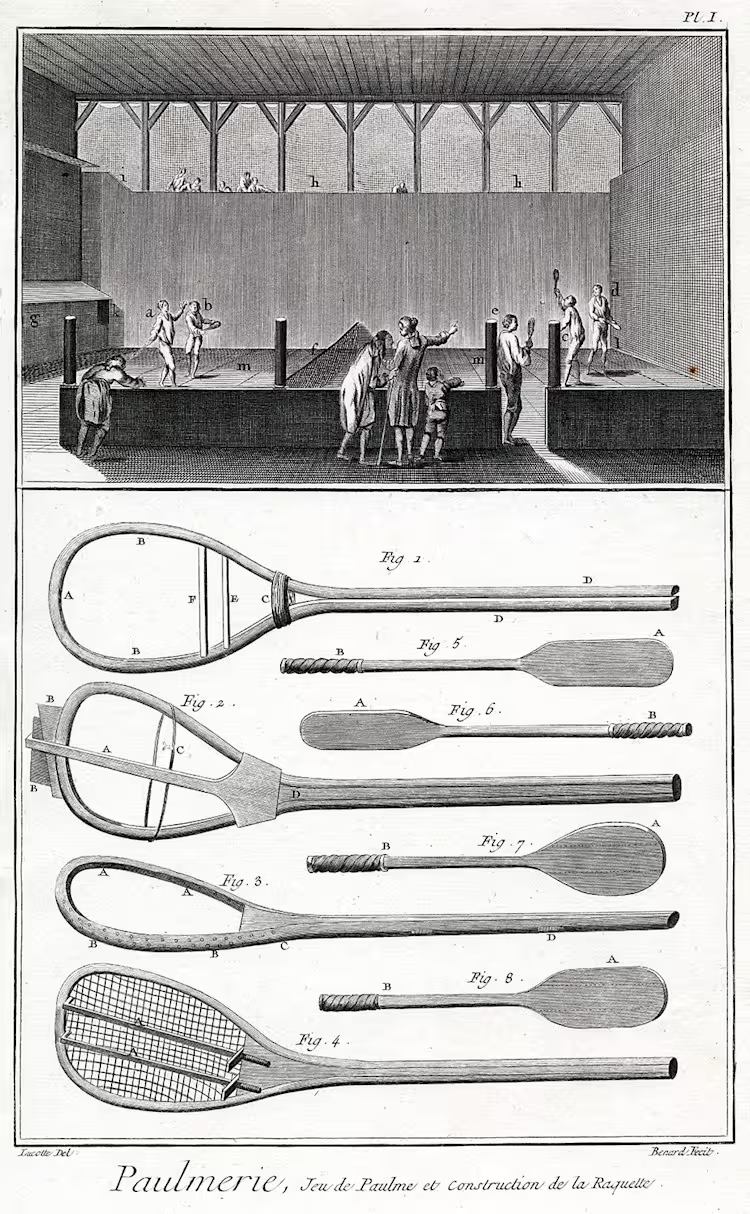
A modern tennis racquet also looks nothing like its ancestor from 100 years ago. “Development of such an essential and personal piece of equipment has been no simple task over the years. Rather, tennis racquets have evolved immensely…” (International Tennis Hall of Fame). Tennis racquets started as a wooden paddle. The sport was further formalized in the early 20th century, and wooden rackets were used until 1980, despite significant innovation in racket design. In the early 1960s, after WWII, metal rackets were adopted; later, graphite rackets were adopted; today, a variety of materials are used. This technology has allowed for a much greater increase in power and accuracy in tennis. Tennis racquets today are also optimized for playing style, rather than a player's level. This allows for an even more exciting game with the exaggerated personalities of various players coming through on the court.
Old tennis was probably much more fun to play than to watch. It was a fairly slow sport in which athletes used oversized, clunky wooden paddles to hit a ball across a court. With new tennis rackets, athletes can hit the ball significantly faster and more accurately, making for a more exciting game. As Evolve Tennis puts it, these technological innovations have enhanced the functionality of tennis racquets and deepened the sport’s strategic complexity, allowing players to choose equipment that best complements their individual skills and tactics. Now that is an exciting game!
So, what is the difference between the sports where technology has been embraced and those where it has not? I think a few things are coming into play. First, unfamiliarity seems to be a major point of contention throughout. Tennis racquets evolved slowly over 100-plus years; the 3% improvement that gave Kipchoge the edge seemed to happen overnight when Nike developed carbon-plated shoes (Nike). Likewise, VAR was developed and adopted over a few years. On the other hand, Hawk-Eye was first unveiled almost 20 years ago and has been developed since then, well before games became fully dependent on it, allowing fans to become more comfortable with it.
Secondly, and perhaps more importantly, is the level of transparency. Modern tennis admirers know that when they are watching a game of tennis today, it is not pretending to fit within the framework of “old tennis”. Instead, it uses better equipment that gives players a significant advantage and exaggerates their play style. Additionally, they can instantly see and understand the reasoning behind Hawk-Eye calls. Football fans, on the other hand, must wait for a painful few minutes in a seemingly unnecessary build-up before being told a frustrating “computer says no”. Additionally, Kipchoge’s use of “super shoes” at a privately held event wasn’t initially advertised publicly. There wasn’t a giant banner during the broadcast saying, “Yes, we know he’s using super shoes, but he’s probably still faster than you.” Nonetheless, despite Kipchoge's extraordinary run, it probably should not be considered fully competitive. There is a lack of transparency around technology in football and running that Tennis has provided to spectators.
I think this helps us determine how much of a technology boost is acceptable. A BattleBots fan would tell you to forget athletes altogether and build a weaponized super-ultra-monster robot that literally demolishes its competition. A football or running fan would reject any technological influence whatsoever. Tennis seems to sit somewhere in the middle. What seems clear is not a single answer but a principle: if audiences know exactly what they’re watching and the tech being used is transparent, then almost any level of technological influence is ok. Perhaps one day we’ll have cyborg racing, with people using power suits that double their speed.
If this is communicated properly, then I believe there will always be people excited to line up.
Process Statement
Kipchoge’s run still genuinely fascinates me to this day. There was a lot of controversy at the time, and eventually, world athletics allowed carbon-plated shoes, imposing strict limits on stack height (how tall the shoe is) to try to limit their influence. Note, the effectiveness of this regulation is often questioned. Additionally, I’ve never been a fan of football (soccer), but I remember a lot of my friends complaining about VAR when it first came out. It was these two questions that really sparked my interest in the topic for me: how much modern sports are helped by athletes? Does that even matter?
I used Grammarly assistant lightly. I only used it to point out places where my phraseology could be better, and tried my own rewrites before using its suggestions. I also did not listen to all its suggestions. My hope is that this will still carry my voice while presenting my opinions and research more effectively. The only research that used GenAI was stated and cited in the paper. Finally, something I found extremely helpful was Google Docs' ability to manage citations. It has a feature that lets me paste a URL and try to find any existing citations for that website. Otherwise, it is fairly easy to manually cite and manage citations. All in all, I really enjoyed exploring this topic and had great fun researching it.
References
- AnalyiSport. “What is VAR (Video Assistant Referee)?.” AnalyiSport, 14 March 2023, https://analyisport.com/insights/what-is-var-video-assistant-referee/. Accessed 16 March 2026.
- BattleBots. “Home.” BattleBots, 2026, https://battlebots.com/. Accessed 25 March 2026.
- BattleBots. “2022 Design Rules.” no. 2022.0, 2022. BattleBots, https://battlebots.com/wp-content/uploads/2022/09/BattleBots-Design-Rules.2022.0.pdf. Accessed 25 March 2026.
- Boyo, Sydney. “How Sony's Hawk-Eye electronic line-calling system transformed the U.S. Open.” CNBC, 9 September 2023, https://www.cnbc.com/2023/09/09/how-sonys-hawk-eye-works-at-the-us-open.html. Accessed 21 May 2026.
- Buckingham, Philip. “VAR: What's wrong and how to fix it.” The New York Times, 11 March 2026, https://www.nytimes.com/athletic/7086296/2026/03/05/var-referee-problems-fix/. Accessed 16 March 2026.
- ChatGPT. “Evolving Sports Over Time.” Response to "what are the top 5sports that have changed fundmanetally in the past 100 years? i.e a sport that a modern viewer today would have no clue what had changed. outline some of the crazy technological innovations that have happened". GPT-5.4. 25 March 2026. OpenAI, https://chatgpt.com/c/69c4769b-c150-832e-9355-51a5e3269bee. Accessed 25 March 2026.
- Evolve Tennis. “A Brief History and Evolution of Tennis Racquets..” Evolve Tennis, 2026. Accessed 21 May 2026.
- INSIDE FIFA. “FIFA holds successful first official “semi-live” tests with Video Assistant Referees (VARs).” INSIDE FIFA, 02 September 2016, https://inside.fifa.com/news/fifa-holds-successful-first-official-semi-live-tests-with-video-assist-2830365. Accessed 16 March 2026.
- International Tennis Hall of Fame. “Smash Hit.” The Evolution of the Tennis Racquet, 2026, https://racquets.tennisfame.com/. Accessed 25 March 2026.
- Muniz-Pardos, Borja, et al. “Recent Improvements in Marathon Run Times Are Likely Technological, Not Physiological.” Sports Medicine, vol. 51, no. 3, 2021, pp. 371 - 378. YU Library, https://doi.org/10.1007/s40279-020-01420-7. Accessed 23 March 2026.
- Nike. “Nike Air Zoom Alphafly NEXT%.” Nike, 2026, https://www.nike.com/vn/running/alphafly. Accessed 16 March 2026.
- Philofer, Aron. “Hawk-Eye Wins Over Players, Fans and Officials.” New York Times, 6 Sep 2008, https://archive.nytimes.com/straightsets.blogs.nytimes.com/2008/09/06/hawk-eye-wins-over-fans-officials-and-players/. Accessed 21 May 2026.
- TennisHQ. “How Hawk-Eye Technology is Changing the Game: A Closer Look at Tennis and Beyond.” TennisHQ.co.uk, 29 January 2024, https://www.tennishq.co.uk/blogs/news/how-hawk-eye-technology-is-changing-the-game-a-closer-look-at-tennis-and-beyond. Accessed 07 April 2026.